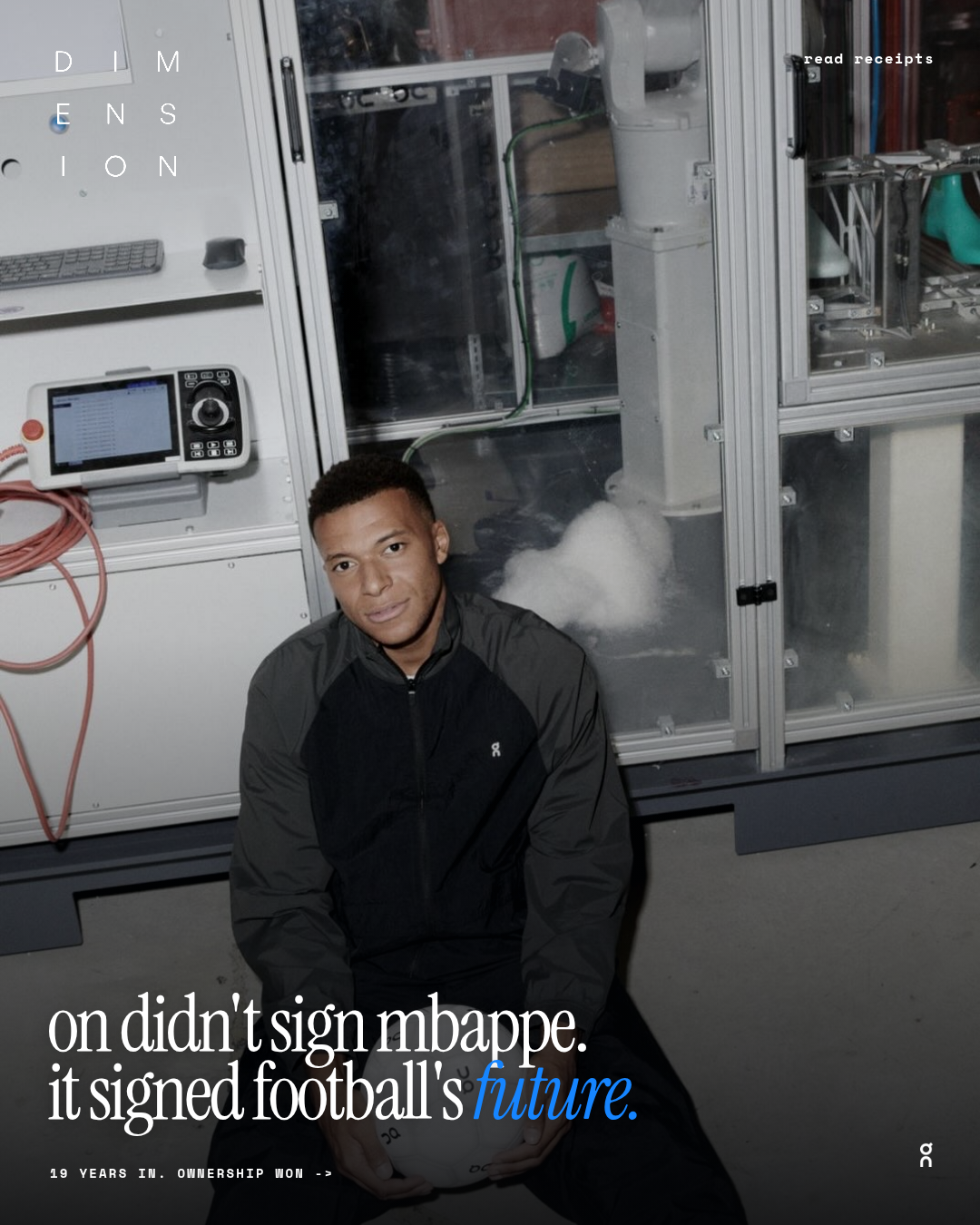
the pipeline was the moat
nineteen years is long enough for a relationship to stop looking like a deal and start looking like infrastructure. that is what makes mbappé leaving nike different.
kylian mbappé has left nike after roughly nineteen years. not for adidas, the rival everyone knows how to place on a football map, but for on, a swiss running brand that did not have a football division until now.
the easy reading is sponsorship. the better reading is structural. nike's advantage in football was never only the boot, the campaign or the cheque. it was the pipeline: identify the player early, put the swoosh on the dream, then make the relationship feel permanent before the rest of the market can compete.
mbappé was that pipeline working exactly as designed. he wore nike from the age of eight. his rise from clairefontaine to monaco, paris and madrid played out inside the same commercial world. the brand did not meet him at the summit. it had been there almost from the start.
which is why this is not a challenger winning an auction. it is an incumbent losing its own proof of concept.
nike can replace campaign reach. it can sign another player, release another boot and buy another summer. what it cannot quickly replace is the belief that its pathway still ends in loyalty. when the athlete who grew up inside the machine chooses a different future, the machine becomes visible.
on understood that a normal endorsement would not carry enough weight. it has reportedly signed mbappé to a ten-year deal. per the athletic, the arrangement includes equity, with a signature sub-brand also reported. the length matters, but the structure matters more.
a paid face borrows the brand's platform. a shareholder has reason to expand it. an ambassador appears in the campaign and leaves when the shoot wraps. an owner can recruit, open doors, shape product and make the next move feel like part of a bigger build.
that is the actual purchase. on did not buy mbappé's audience for a season. it bought alignment with the person carrying that audience.
henry makes the promise believable
a football division can be announced in a press release. credibility has to arrive in the room before the product does.
thierry henry is on's director of football. that title turns the mbappé deal from a celebrity acquisition into the outline of an institution.
henry is not standing next to a shoe as proof that somebody famous likes it. he is inside the structure. he brings product credibility, dressing-room credibility and a reason for the next nineteen-year-old to believe the football offer is real before the marketing says a word.
the old sponsorship model separated the people with cultural authority from the people with organisational authority. athletes carried the story while executives controlled the future. on has collapsed that distance. the legend helps run the division. the current star owns part of the upside.
from clairefontaine to the boardroom. one photo, a kid in a france shirt next to his idol. today, co-owner and director of the same brand.
the photograph matters because it makes the deal legible without a deck. the relationship between henry and mbappé already exists in football's memory. on has turned that memory into company architecture.
this is the generational handover the largest brands usually stage in advertising: the legend welcomes the heir, the product sits between them, the film closes on a logo. here, the handover is happening inside the business. one generation is helping build the division while the next owns part of what it becomes.
that changes what a challenger can offer. nike still has scale, distribution, history and an athlete roster that on cannot copy overnight. but scale is no longer the only form of status available to a player. authorship is status. equity is status. helping create the thing rather than entering a finished machine is status.
for a generation of athletes already operating as media companies, investors and founders, the richer offer is not always a larger fee. it is a larger role.
the challenger playbook has moved from access to authorship
new balance proved a challenger could borrow football legitimacy through a club and win trophies inside it. skechers showed an outsider could take a category-defining striker. on has gone further: the best player in the world, a legend running the division and an ownership structure that makes both men part of the build.
nike is not losing athletes because smaller brands suddenly became bigger. it is losing them because smaller brands can make bigger offers. not bigger in cash alone, but in control, identity and upside.
that pressure will travel. once one athlete is seen moving from endorsement to equity, the next negotiation begins from a different place. the question is no longer only how much a player is worth to a brand. it is how much of the brand the player should help own.
losing one athlete is a news cycle. losing the model that kept athletes for life is the strategy problem.
the call
on has made the smartest football deal of the year because it built an ownership story, not an endorsement campaign.
the second-order read
the next generation of elite athletes will compare roles, not only cheques. incumbents now have to defend the structure of the relationship.