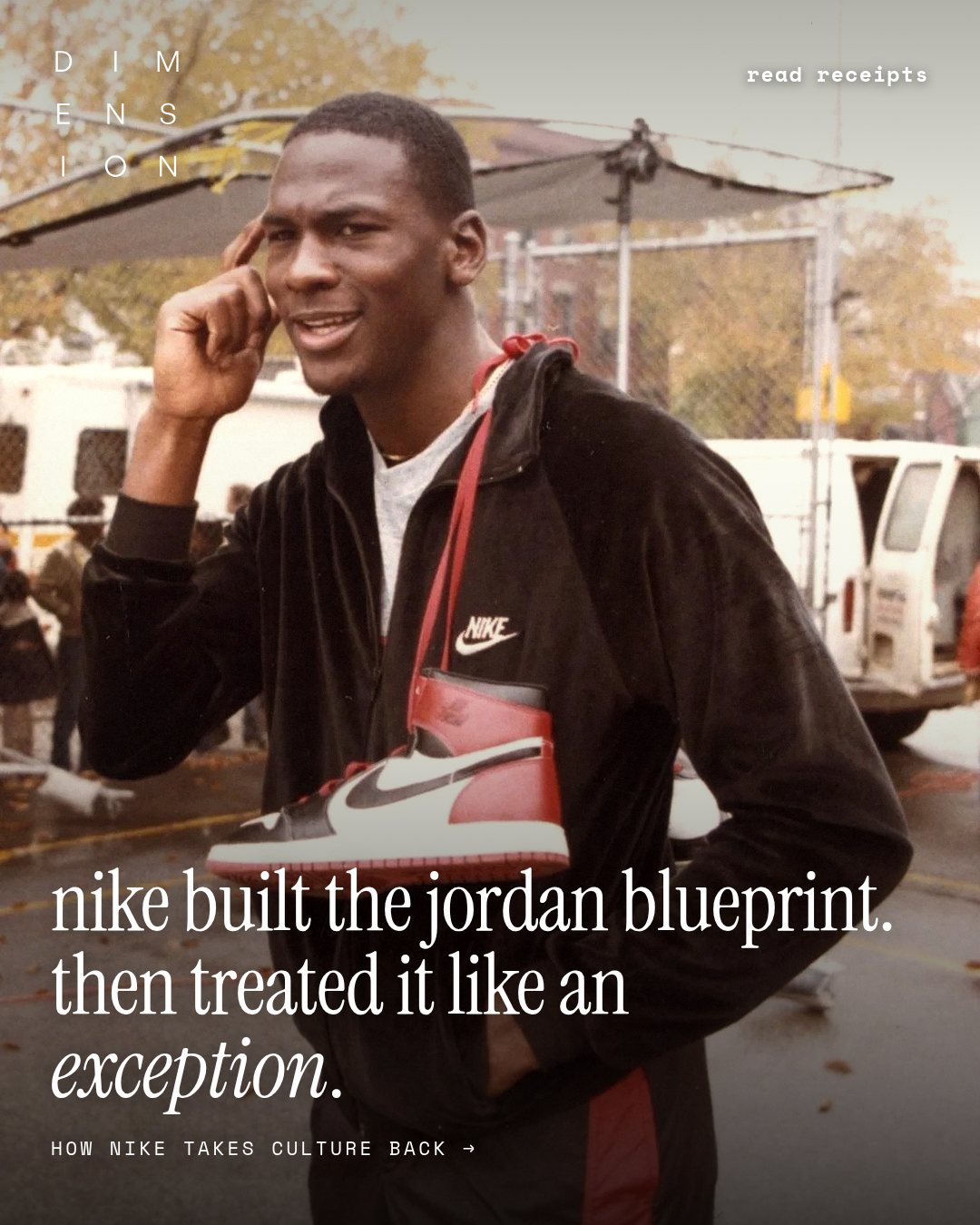
Nike built the most valuable athlete-brand blueprint in sport. Then spent forty years treating it like an exception.
Now On has hired Thierry Henry to help build football and put Kylian Mbappé at the heart of creating the category. The irony isn't that Nike lost an athlete. It's that a challenger is modernising the future Nike invented.
Nike already collaborates with athletes at serious depth. A'ja Wilson spent over a year co-creating her signature collection. Serena briefs product and sits in design reviews. Mbappé himself had repeated Nike player editions and custom boot builds.
So "give athletes more input" isn't the gap.
Nike's athletes author collections. On's are being asked to found categories.
And the cost of standing still is visible: Nike's World Cup boot share has slid from 62.8% in 2018 to 42.8% in 2026.
Nike invented this model. Jordan proved a royalty-bearing athlete relationship could become a durable world of its own.
But Jordan was the exception, never the system.
The Athlete Founder model is one system with two applications:
1. New World - for a category or adjacency Nike is entering. One or two defining athletes, a multi-year charter across the product platform, emerging-athlete recruitment, cultural direction and participation, with economics tied to the durable enterprise they help create.
2. Category Re-Founder - for the worlds Nike can no longer take for granted. A three-season, ring-fenced recovery mission inside football, running or basketball, built around a precise gap: make Nike the most desired football brand among 14-21-year-old player-creators in Europe's key cities.
That athlete gets founder-like power over a bounded world:
✓ Shared IP and long-horizon economics - a reason to build durable codes, not launch-cycle heat
✓ A product system, not one signature drop
✓ Authority over the emerging-athlete and creator roster
✓ The grassroots pathway and community partners
✓ Rituals, storytelling and marketplace moments
✓ A veto over campaigns that break the world
Nike keeps the P&L, performance standards, supply, legal and final scale-up. A field council of younger athletes, coaches and creators stops the world becoming one superstar's taste bubble.
Success is new-to-Nike acquisition, repeat purchase, full-price sell-through, performance adoption and cultural preference - and whether the world survives the athlete's exit. Not impressions. Not one shoe selling out.
Nike should not hand its biggest sports to superstars. It should give a small number of athletes founder-like power over precisely defined recovery missions, then turn their wins into a repeatable company capability. The system, not the superstar, remains the hero.
The cautionary tale is already written.
Under Armour gave Curry "space to build something much bigger than a shoe" in 2020. They separated in 2025, with basketball - Curry Brand included - guided at $100-120m for FY26.
Authorship can't outrun weak parent execution.
Nike does not need to give athletes more input. It needs to give the right athletes founder-like power over the category worlds it must create - and the ones it needs to win back.
Nike built its reputation on seeing the athlete-brand relationship before everyone else did.
It hasn't lost the right to lead that future. But Jordan cannot remain the exception that proves Nike once understood it.
The next era starts when Nike turns its most progressive athlete partnership into a repeatable path - from signature athlete to category founder.