the old luxury equation was simple: make the object scarce, wrap it in status and let ownership do the rest.
that equation is weakening.
bloomberg reported on 15 september 2026 that lvmh is poised to lose its position as france's most valuable company and leave europe's top 10 listed companies by market value. its chart places lvmh at number 11, behind l'oreal, and marks the first time it has fallen outside the group since 2017. lvmh shares are down about 37% this year.
one company moving down a market-cap table does not explain an entire cultural shift. lvmh's performance has several causes, including weaker demand in china and pressure across the wider luxury market.
but the public reaction beneath bloomberg's post shows what the number has come to represent.
the most-liked comment, with 116 likes, read: "shifting consumer habits! people now care about experiences more than luxury items."
that is the story people saw in the chart.
the crowd read three signals
the comments split into three clear threads.
the first was the shift from things to experiences. it was the strongest response by likes and the closest to the wider market evidence.
the second was china. several people pointed to cooling demand, writing "no more china market growth", "they are nothing without buyers from china" and "chinese have matured". lvmh's fall is not happening in a vacuum. the engine that carried european luxury for years is changing.
the third was more emotional: a rejection of luxury that feels industrial, inflated or empty.
"the world wants handmade not a bunch of conglomerates," one comment said.
another read: "their mass-produced 'luxury' could have reached its peak."
a blunter thread said people were tired of being scammed.
these are comments, not market research. they do not prove why lvmh's share price fell. but they are useful cultural evidence because they show what people now suspect about the category.
people are not simply questioning the price of luxury. they are questioning what sits behind the price.
people are not rejecting luxury. they are rejecting luxury without meaning.
bain & company's 2026 luxury market update says experiences continue to outpace tangible goods as consumers prioritise meaning over ownership. cnbc's reporting on the study puts it plainly: travel, events and dining are becoming more important than buying status goods for show.
that does not mean the luxury product is dead. it means the product has a harder job.
a bag, watch or garment once carried the whole message. it showed taste, access and status. now the object increasingly needs a world around it. people want the dinner, the run club, the hotel, the live show, the temporary space, the people they met there and the story they can retell.
the backlash against "mass-produced luxury" sharpens this point.
craft still has meaning. rarity still has meaning. a handmade object with a clear maker, material and story still gives people something to believe in.
what is losing force is scale disguised as scarcity. when the product feels mass-made but the language around it still asks for reverence, the spell breaks.
that is why the move towards experiences is bigger than a change in spending. it is a demand for proof.
people want to feel the care, enter the world and see where the value came from.
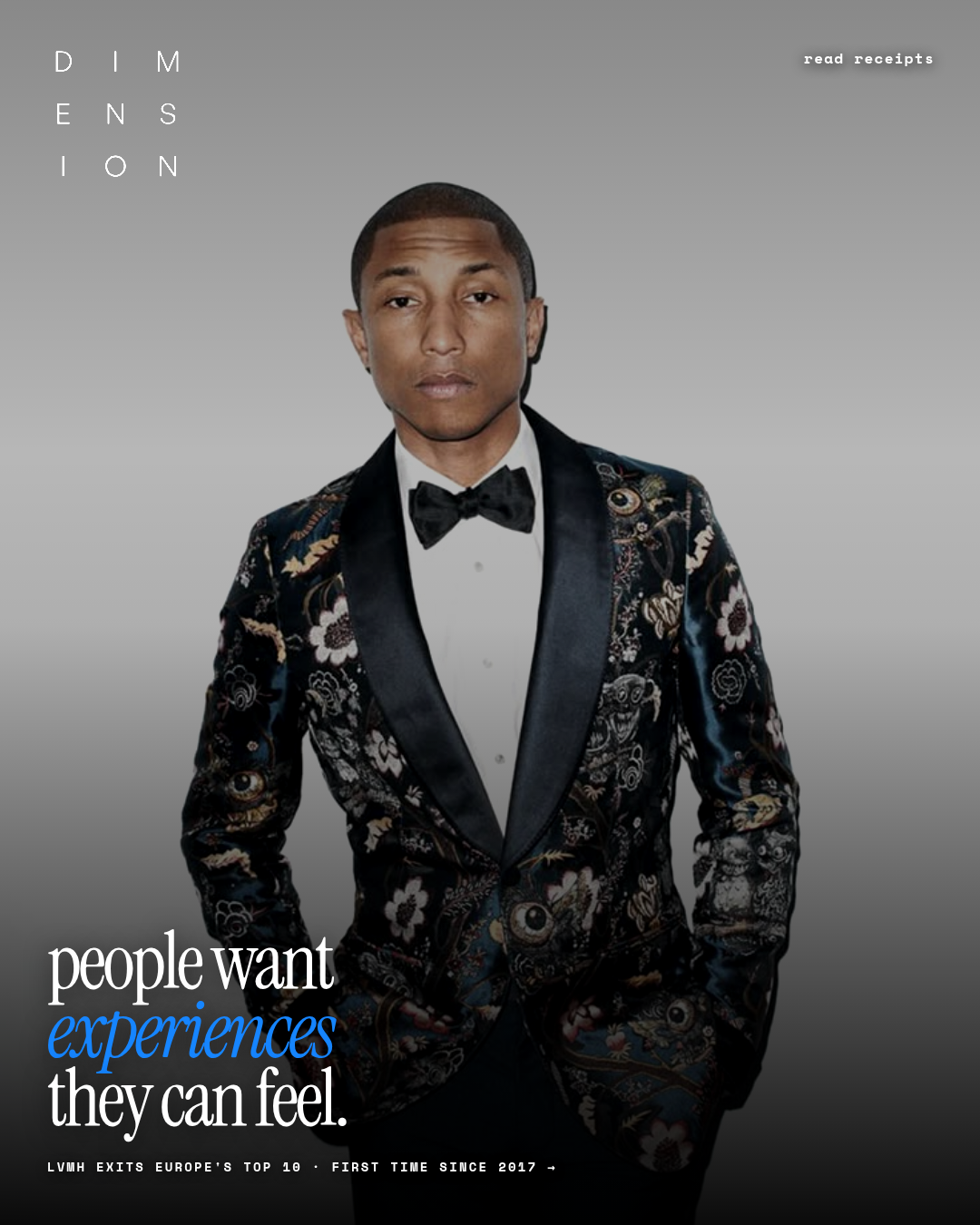
pharrell is already the answer inside the building
louis vuitton made an unusual choice in 2023. it put pharrell williams in the men's creative director seat.
he was not presented as a conventional leather-goods technician. louis vuitton's own announcement praised his creative vision "beyond fashion". his first show then turned the pont neuf into a stage for 1,750 guests, bringing fashion, music, architecture and celebrity into one live moment.
that appointment reads differently now.
lvmh already put a producer of experiences inside one of its most important creative roles. pharrell understands how to turn a release into a world, how to make people feel present at a cultural moment even when they are watching through a screen, and how to let music, place, people and product carry the same idea.
who better to help answer a shift from ownership to experience than a creative director whose real material is attention, participation and memory?
the point is not that spectacle can fix weak demand. it cannot. the useful part of pharrell's appointment is that it expands what the creative director is there to direct. not only the product, but the whole encounter around it.
that is the bet luxury needs more of.
experiential marketing is moving to the centre
experiential marketing has often been treated as an extra layer: a launch event after the campaign is finished, a pop-up built for photographs, or a sponsorship sitting beside the main media plan.
that hierarchy no longer matches consumer behaviour.
if experiences are taking a larger share of attention and discretionary spend, experiential cannot stay at the edge of the campaign. it has to shape the campaign itself.
an experience does something an advert cannot do on its own. it gives the audience a role. people do not merely watch the brand's world. they enter it, move through it and leave with evidence that they were there.
that participation creates three kinds of value at once:
- cultural value, because the brand becomes attached to a real moment and a real group of people.
- creative value, because the experience produces images, stories and behaviour that paid media can carry further.
- commercial value, because attention is earned through involvement rather than rented one impression at a time.
this is the second-order change. experiential is not competing with advertising. it is becoming the source material for advertising.
status is becoming participatory
luxury has always sold more than function. it sells access, identity and belonging. what is changing is how those signals are expressed.
visible ownership still matters, but participation carries more weight than it used to. being at the right run, dinner, show, trip or cultural moment can signal as much as the item someone brought with them.
that helps explain why hospitality, sport, travel, food and live entertainment matter to brands outside those categories. they are not only looking for another sponsorship surface. they are looking for a place where meaning is already being made.
there is a trap here.
a logo at an event is not community. a photo queue is not culture. people can tell when an experience exists only to generate content for the brand.
the work has to begin with a truth about the audience: where they already gather, what they care about there and what the brand can add without flattening it.
the market value is shifting because value itself is shifting
one commenter wrote that when europe's former largest company falls out of the top 10, it is more than a ranking change. it signals how quickly global demand, and the sectors carrying europe's market value, can move.
that comment had 81 likes.
another asked whether this is a temporary dip caused by global headwinds or a deeper change in the luxury market's resilience.
the honest answer is that both can be true. china can cool. economic pressure can make a £3,000 purchase harder to justify. technology companies can take a larger share of europe's market value. luxury groups can recover.
but none of that erases the cultural signal underneath the reaction.
consumers are asking more of the object than the object alone can give them.
at svnth, this is why we build from the world outwards.
the experience is not a decorative finish. it is the organising idea. the physical moment, creator layer, film, social distribution and paid media should all feel like parts of the same system.
the lvmh chart is not a declaration that products no longer matter. it is a warning against believing the product can carry the whole brand by itself.
people still buy objects. increasingly, they remember what the object let them enter.
experiences are moving from the campaign edge to the centre. craft, meaning and participation are becoming the new proof of value.
sources
- louis vuitton press release announcing pharrell williams as men's creative director, 14 february 2023: https://press.louisvuitton.com/men/louis-vuitton-annonce-pharrell-williams-en-tant-que-directeur-creatif-homme-20699/?lang=en
- vogue, pharrell williams' louis vuitton debut on the pont neuf, 21 june 2023: https://www.vogue.com/article/a-star-studded-ode-to-paris-pharrell-makes-his-louis-vuitton-debut
- bloomberg business, instagram carousel and public comments, 15 september 2026: https://www.instagram.com/p/DdT0mUyID9a/?img_index=1
- cnbc, "luxury spending now driven by experiences and 'inheritourism'", 25 june 2026: https://www.cnbc.com/2026/06/25/luxury-spending-now-driven-by-experiences-and-inheritourism.html
- bain and altagamma 2026 luxury market study release, 25 june 2026: https://www.prnewswire.com/news-releases/global-luxury-stabilizes-amid-compounding-disruptions-as-brands-race-to-amplify-meaning-and-rebuild-relevance-302810874.html