Converse pulled its own ad this month. Not after a legal letter, not after a press inquiry.
But after the comments found something the entire approval chain had walked straight past.
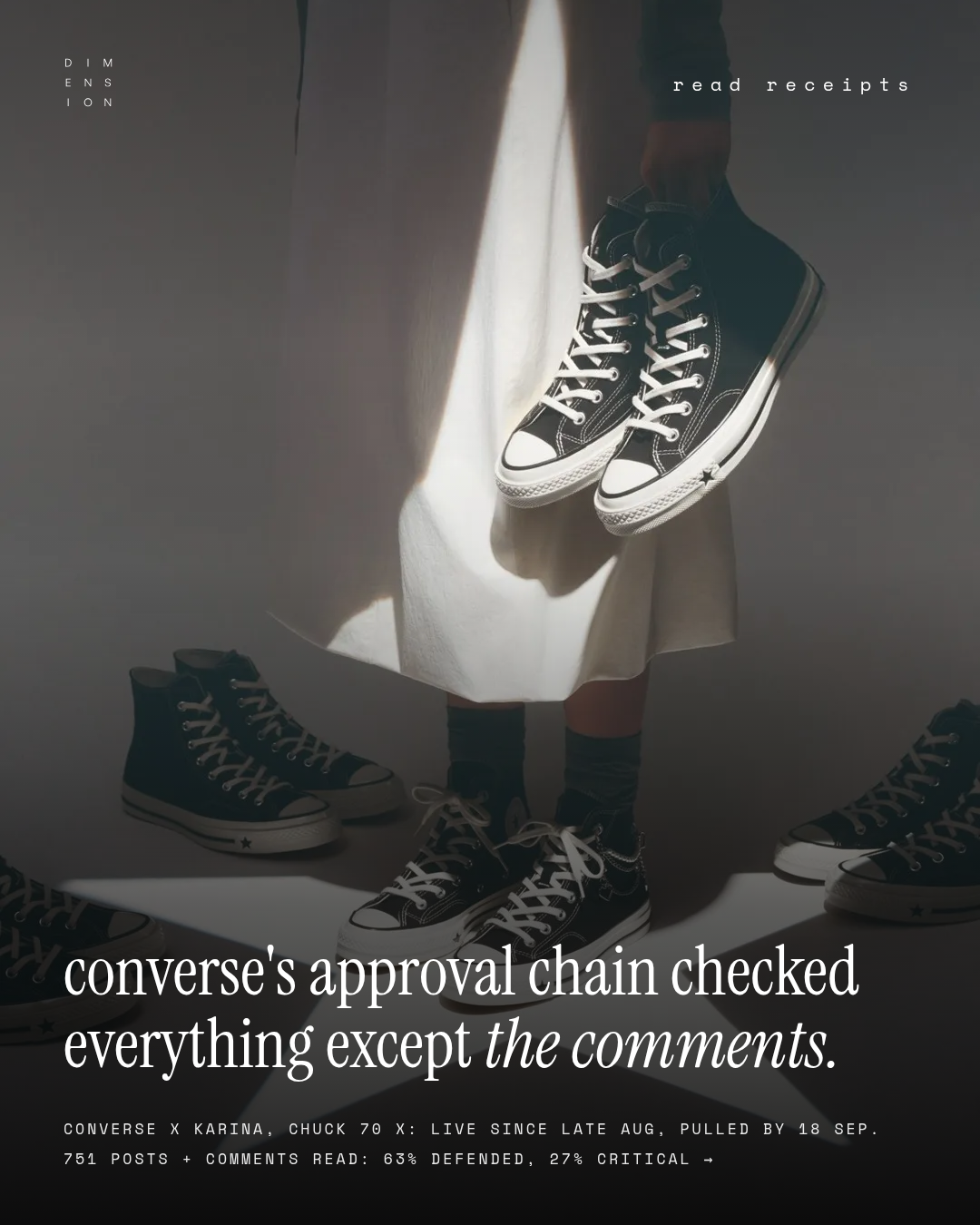
The ad was part of the Chuck 70 X campaign with Karina from girl group 'aespa': the lower half of a figure in a white, calf-length garment, dark sneakers alongside. The internet looked at it and saw a KKK robe, a triangular shadow, shoes that appeared to hang. The image had been live for weeks - on Converse's own Chuck 70 X page since late August, then in a 3 September Threads post.
Once the comments found it, the end came fast: pulled from Converse's channels, with an apology out by 18 September: "We're sorry. We understand why this image is deeply upsetting and recognize that we got this wrong." A week after the apology, Converse told employees it was pausing all marketing.
Sit with what that means.
This image cleared every layer of review a global brand owns. Converse declined to answer questions about how the ad was screened, but a launch like this one passes legal, an agency, a brand team and a superstar's management - and every one of them saw it. Nobody is accusing any of them of malice - that's precisely the point. Every approval chain in the industry is built to check the work against the brief and the brand guidelines. Nobody's chain checks the work against the internet's imagination.
The gap is now the most expensive real estate in marketing.
Here's the part the industry keeps skipping. The comments didn't just complain. They moved the number. Brand sentiment stopped being a quarterly survey a long time ago - it's a live wire running under every launch, and the first day of a campaign now decides whether you have a launch or an apology.
Converse's apology was genuinely good. Fast, human, no lawyering. But the save is not the story. The story is that the warning system exists and wasn't plugged in. Somewhere between hour one and the pullback, the sentiment curve told them everything the review process hadn't.
The early data says the backlash was real, but concentrated - and it was arguing process.
In a purposive Vorly scan of 751 public posts and comments about the ad, dated 17-28 September and collected on the 28th (query-led and model-coded, not a representative sample: the X figures come from nine high-engagement threads, eight of them defense-leaning, and the Instagram numbers are ranked top comments under Converse's and Karina's own posts), 547 items carried a stance.
63% defended the brand or dismissed the critics; 27% were critical of the image; 9% attacked the apology itself.
The split that matters is where the criticism lived. On Reddit the critics outnumbered defenders 27 to 5; on X it ran 196 to 15 the other way. And when Converse took the campaign posts down, the anger didn't disappear, it migrated: 44 critical comments flooded two unrelated Jack Purcell posts on Instagram while the ranked top comments under Karina's own latest post stayed fan support.
The critical camp's loudest themes were the vetting process itself - who approved this - and the cross-cultural read: the comments' own explanation had a regional team - Korea or Malaysia, depending on which thread you read - making the ad for Asian markets, and American readers saw Klan imagery. Not the ambassador. Not a simple boycott, either: stated behaviour ran both directions, boycott calls and counter-buying. The crowd's verdict landed on exactly the question the approval chain never asked. The engagement split ran the same way: as of 28 September, the most-liked critical comment in the sample had 11,587 likes, the top defense comment 31,101.
This is the third time in five weeks a global brand has discovered that the final round of approval happens in public, after launch, for free: Callaway pulled its Good Good ad and Target pulled a Halloween costume in August, both after the crowd found them. The pattern is always the same: the chain checks intent, the crowd checks impact, and the crowd is faster.
The uncomfortable question.
Every brand running big campaigns right now has a version of this exposure. The approval chain has six signatures on it. None of them belongs to the person who will actually decide whether the campaign survives: the first ten thousand people to see it.
So the question worth stealing isn't "how did Converse miss this?" It's this: when your next campaign goes live, where does the first day of sentiment actually go? A dashboard someone checks on Friday? A weekly report? Or the room where the pull-or-push decision gets made?